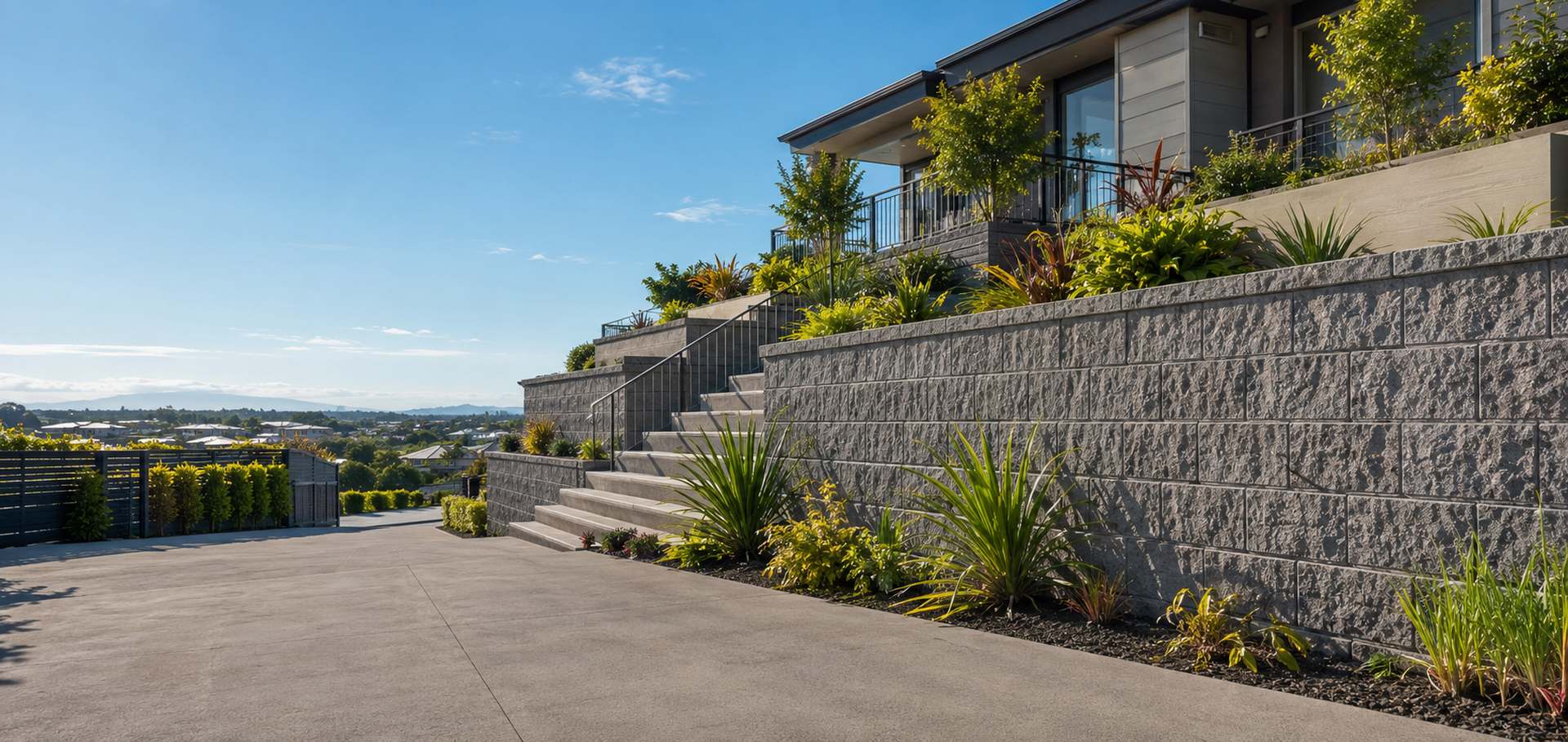
Top Retaining Walls Christchurch builds Firth Keystone retaining walls in Christchurch. Keystone is a segmental system, which means the blocks lock together with fibreglass pins rather than mortar. The wall goes up dry, it steps around curves, and it flexes slightly instead of cracking when the ground moves.
Keystone Compac III blocks with the pin connection system
Up to 1m with an 8 degree setback and no surcharge
Geogrid reinforcement for taller engineered walls
Drainage on every wall300mm of metal, a drain coil and geotextile. Never an optional extra.
H5 poles as standardThe right treatment for timber that lives in wet ground.
Consents handledChristchurch City, Selwyn and Waimakariri, start to finish.
Itemised quotesYou see what the drainage and the spoil actually cost.
How the Keystone system works
Each Compac III block drops onto pins set in the course below, and those pins hold the setback automatically. The wall leans back about 8 degrees as it rises, which puts the mass of the blocks working against the soil. There is no mortar and no grout in a standard build.
Firth rates a standard Compac III wall to 1m with that setback, as long as there is no surcharge and no sloping toe. Past that height the wall needs an engineered design, usually with geogrid layers running back into the fill.
Keystone Retaining Walls at a glance
Block
Firth Keystone Compac III, rockface or straight face
Connection
Keystone pin system, no mortar
Setback
About 8 degrees, built in by the pin position
Standard height
Up to 1m with no surcharge and no sloping toe
Taller walls
Engineered design with geogrid layers into the fill
Base
Compacted granular levelling pad below finished ground
Finish
Sealing recommended where the wall stays damp
Concrete block retaining wall built in Christchurch.
Geogrid is what lets a Keystone wall go taller
Geogrid is a stiff plastic mesh laid horizontally between block courses and extending back into the compacted fill. It ties the block face to a large block of soil behind, so the wall and the soil work as one mass rather than the blocks trying to hold everything on their own.
That is how you get a 2m or 3m segmental wall. It is also why the excavation behind a tall Keystone wall is much bigger than people expect. We show you the dig footprint at the quote so it is not a surprise on day one.
Curves, steps and corners
Segmental blocks are the easiest way to build a curved retaining wall. Each block pivots a small amount against its neighbour, so a long sweeping radius comes out smooth rather than faceted. Corner blocks and capping units finish the ends properly.
This is why Keystone shows up so often on new builds in Wigram, Halswell and Rolleston, where the landscaping plan has curved beds and stepped terraces rather than straight boundary runs.
Colour and finish on Keystone blocks in Canterbury
Compac III comes in a rockface and a straight face, in more than one colour. Because the blocks use locally sourced aggregate, colour varies a little by region, so we get samples on site before you choose rather than picking from a screen.
Firth recommends sealing masonry to protect against efflorescence and staining where the wall stays damp. On a shaded south facing wall in Christchurch that is worth doing.
Every wall we build gets drainage. At least 300mm of clean free draining metal,
a perforated coil at the base running to a real outlet, and geotextile over the top so silt cannot block it.
It is not an optional line on our quotes.
Common questions
Questions about keystone retaining walls
How high can a Keystone wall go without engineering?
Firth rates a standard Compac III wall to 1m with the 8 degree setback, no surcharge and no sloping toe. Anything above that, or with load above, needs an engineered design.
What is geogrid and do I need it?
Geogrid is a stiff mesh laid between courses and running back into the fill. You need it on taller segmental walls. It ties the blocks to the soil mass behind so the whole thing works together.
Can Keystone walls curve?
Yes, that is one of their real strengths. The blocks pivot slightly against each other so a curve comes out smooth. Timber cannot do that.
What people say
Reviews from Christchurch homeowners
★★★★★
Our old wall was rotten right through and leaning into the neighbour's place. They pulled the lot out, put proper drainage behind the new one and had it finished in three days. Swept the site clean every afternoon before they left too. Tidiest crew we have ever had here by a long way.
MMikeRiccarton
★★★★★
They sorted the consent, which was the bit I was dreading. Dealt with the council so I never had to, and kept me in the loop the whole way through. The driveway sits right above it and has not shifted a millimetre.
TTonyRolleston
★★★★★
Steep section, shocking access, and they still made it look easy. They suggested two smaller walls instead of one big one, which saved us thousands in engineering fees. The terrace in between is now my favourite part of the whole garden.
RRachelCashmere
Where we work
Keystone retaining walls across the city and Canterbury