
Gabion Retaining Walls
Every other wall type fights water. You build a drainage layer, run a coil, wrap it in geotextile and hope nobody blocks the outlet in fifteen years. A gabion wall has no back face to push against. Water.
Read more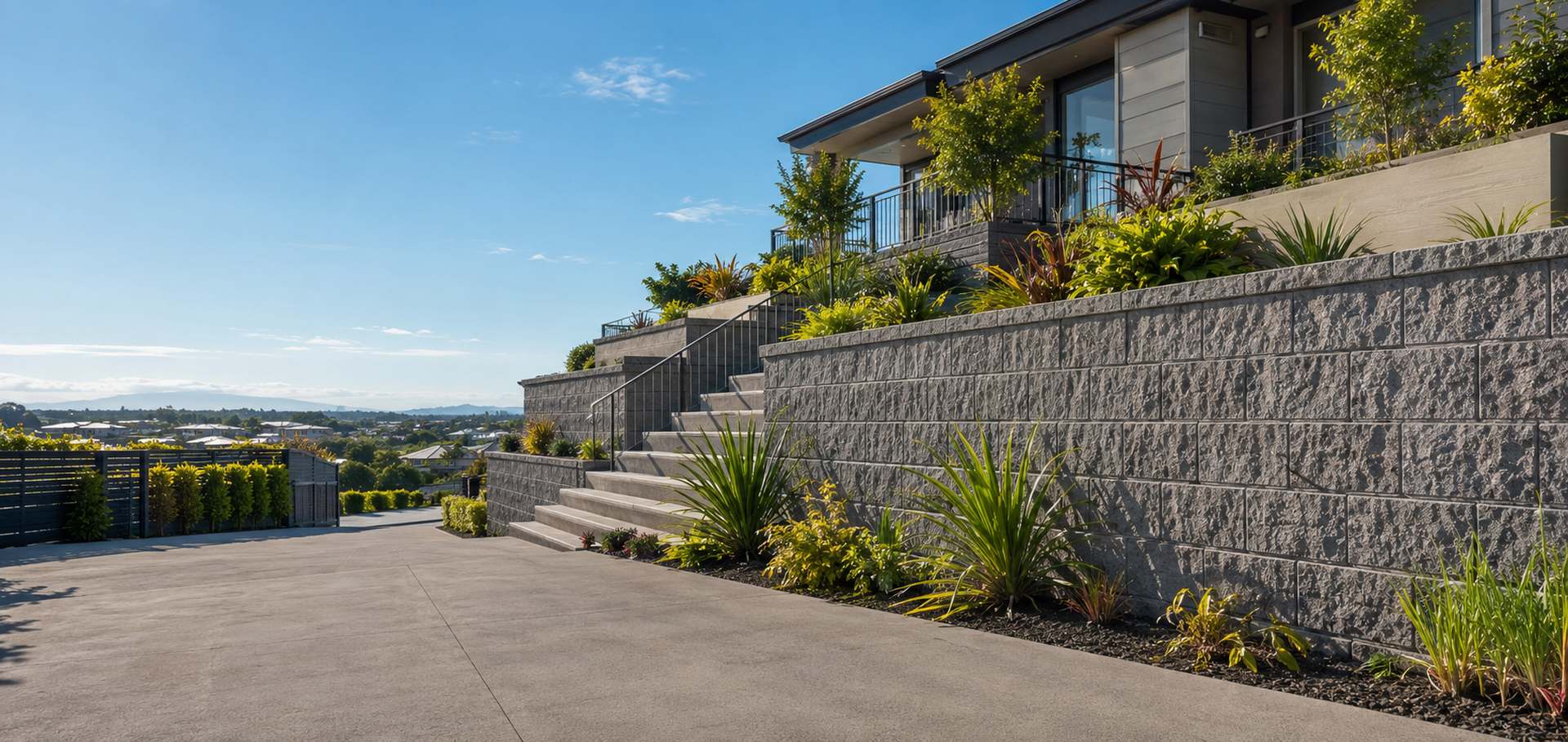
Top Retaining Walls Christchurch builds stone and gabion retaining walls across Christchurch using stone that comes from Canterbury. Halswell basalt, Oxford basalt, Port Hills volcanic rock, Timaru bluestone, schist and river boulders all sit within a short truck run of the city, which keeps the cost sensible and makes the finished wall look like part of the site.
Gabion walls are the practical end of this category. A gabion is a galvanised or PVC coated wire basket packed with 100mm to 200mm rock, and it works as a gravity wall. Water runs straight through the face, so hydrostatic pressure never builds up, and the basket flexes slightly instead of cracking when the ground moves. That flexibility is worth something in Canterbury.
Boulder and dry stone walls sit at the other end. They cost more per metre because a machine operator places every rock by hand and each one has to sit on three points of contact. What you get back is a wall with no visible manufactured edge anywhere on it.
Every other wall type fights water. You build a drainage layer, run a coil, wrap it in geotextile and hope nobody blocks the outlet in fifteen years. A gabion wall has no back face to push against. Water.
Read moreAn operator picks up a rock, offers it to the wall, turns it, sets it down, and often picks it back up and tries a different face. Each boulder has to bear on three points of contact against the rocks.
Read moreThere are two ways to build this. A solid schist wall is a genuine stone structure, laid course by course with the stone doing the retaining. A faced wall uses a concrete block or poured wall behind, with.
Read moreHalswell Quarry ran from about 1861 until 1990 and supplied the distinctive blue grey stone used in the Canterbury Provincial Council Buildings, the Durham Street Methodist Church and the Sign of the.
Read moreThe wall has two faces with smaller stone packed between them, and long through stones set at intervals to tie both faces into one structure. The courses lean back into the bank slightly, and each stone.
Read more
Nearly every failed wall we get called to in Christchurch failed the same way. Water sat behind it, the soil got heavy, and the wall leaned out a little more each winter. So we build the drainage first and the face second.
We cover the whole city plus the Selwyn and Waimakariri towns within a sensible drive.
We will come out, measure it and tell you straight. The site visit and the written quote are both free.