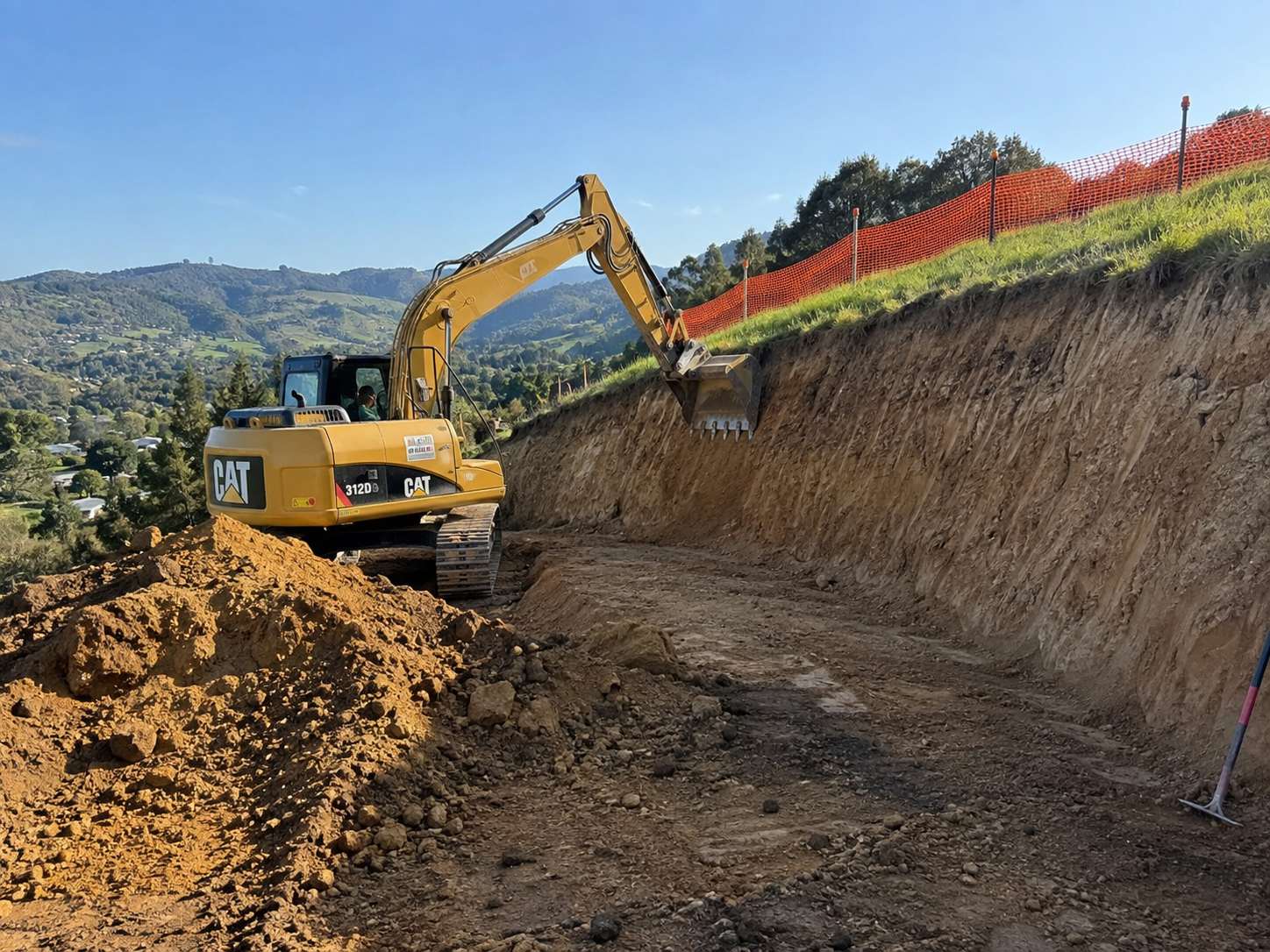
Geogrid Reinforced Retaining Walls in Christchurch
Top Retaining Walls Christchurch builds geogrid reinforced retaining walls, where layers of geosynthetic grid are laid horizontally into compacted backfill at set intervals and connected to the wall face. The result is not really a wall holding soil back. It is a block of reinforced soil with a facing on it.
- Grid layers reinforce the soil behind the wall
- Takes segmental systems well beyond gravity heights
- Always an engineered design
Get your free quote
Four quick questions. Most quotes come back within a couple of days.
This is how modular block systems reach heights a dry stacked gravity wall never could. It is also cheaper than an equivalent poured concrete cantilever on a tall wall, because the soil is doing the structural work instead of a very large footing.
How geogrid reinforcement turns backfill into the retaining structure
The reinforced soil block
Each grid layer extends back into the fill well past the theoretical failure wedge. Friction and interlock between grid and compacted fill mean the whole mass behaves as one coherent block resisting sliding and overturning.
Compaction is structural
On a conventional wall poor compaction means settlement. On a geogrid wall it means the reinforcement never develops its design friction, so compaction is checked in layers and recorded.
Facing connection
The grid has to be positively connected to the facing units, not just laid near them. That detail is part of the engineering and it is where cheap installs cut corners.
What a geogrid reinforced retaining wall needs from the site
Room behind the wall, because the grid extends back a meaningful proportion of the wall height and the ground behind has to be available to excavate and rebuild. On a tight boundary where you cannot dig back, geogrid is not an option and a cantilever or anchored wall is.
It also needs suitable fill. Free draining granular material develops the friction the design relies on. Wet clay does not, and importing fill changes the cost picture.
Geogrid retaining wall cost, consent and inspection
About $260 to $625 per lineal metre depending on height and grid layers, plus engineering. It is essentially always over the consent threshold, so a PS1 and a building consent are part of the job, and inspections verify the grid layers before they are buried.
Geogrid Reinforced Walls at a glance
- Principle
- Grid layers create a reinforced soil mass behind the facing
- Cost
- About $260 to $625 per lineal metre plus engineering
- Requires
- Room to excavate behind, and suitable granular fill
- Compaction
- Structural, checked and recorded in layers
- Facing
- Positively connected to the grid, detailed by the engineer
- Consent
- Always engineered and consented at these heights
Geogrid Reinforced Walls in Christchurch: common questions
How high can a geogrid wall go?
Considerably higher than a gravity wall. Height comes from the design rather than the block system, and multi metre walls are routine.
Do I need room behind the wall?
Yes. The grid extends back a meaningful proportion of the wall height, so the ground behind has to be able to be excavated and rebuilt.
Can any fill be used?
No. Free draining granular fill develops the friction the design relies on.
Is it cheaper than poured concrete?
On a tall wall, usually yes, because the soil does the structural work instead of a very large reinforced footing.
How far back does geogrid need to extend?
A meaningful proportion of the wall height, set by the design so each layer reaches well past the theoretical failure wedge. That is why the ground behind the wall has to be available to excavate and rebuild, and why geogrid is not an option on a tight boundary where you cannot dig back.
Can geogrid be added to an existing wall?
Not without taking the wall apart, because the grid has to be laid into the compacted fill in layers as the wall rises. Where an existing wall needs more capacity and cannot be rebuilt, ground anchors are the usual answer instead.
Why is compaction so important on a geogrid wall?
Because the reinforcement develops its capacity through friction and interlock with the fill around it. Poorly compacted fill does not develop that friction, so the wall does not reach its design capacity even though every layer of grid is in place. That is why compaction gets tested and recorded rather than assumed.
Recent Christchurch jobs
Boundary wall between us and the neighbour on a new build. Sorted the levels, the consent question and the fence on top in one job. Turned up when they said and left the site clean every night.
Builder here. I use them on subdivision work because the paperwork comes back complete. PS1 up front, PS4 at the end, no chasing.
Wall failed after the big rain and took part of the bank with it. Made safe within two days and rebuilt a month later with real drainage behind it.
Terraced the back lawn into two levels. Fast, tidy, fair price, and the drainage was done properly.

Get a price for geogrid reinforced walls in Christchurch
Free site visit, a fixed written quote, and a straight answer on what the wall actually needs.
Start your quote
Four questions and you are done.